| Origin | |
|---|---|
| Date |


A fine, previously unrecorded George I period walnut veneered longcase clock by this famous successor to Thomas Tompion.
The well-proportioned slender case is veneered with well figured walnut onto an oak carcase with book matched panels to the full length moulded trunk door which are repeated on the base which stands on a double plinth. The hood is flanked with turned walnut columns, brass capitals and bases, above which there are intricate sound frets set below the cross grain cornice moulding. The latter is surmounted by a restored Graham caddy top.
The 11-inch square brass dial is mounted with Indian mask spandrels attached with two screws and fine foliate engraved swags between the spandrels. There is a silvered chapter ring with diamond half-hour markers, large seconds ring and bolt-and-shutter maintaining power operated from a lever between II and III o’clock. The dial centre is finely matted with an applied silvered plaque signed by the maker and the dial plate is also signed below VI.
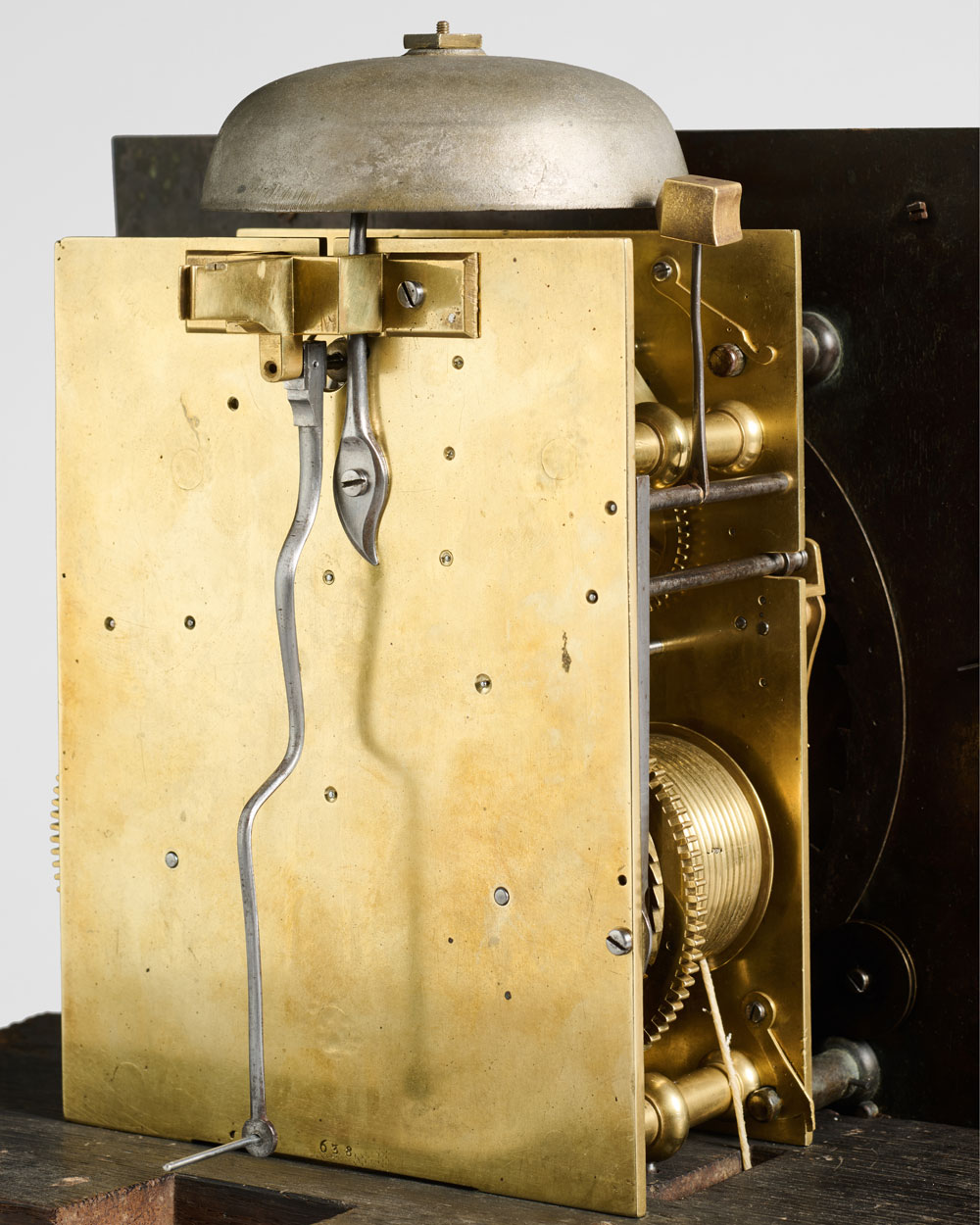
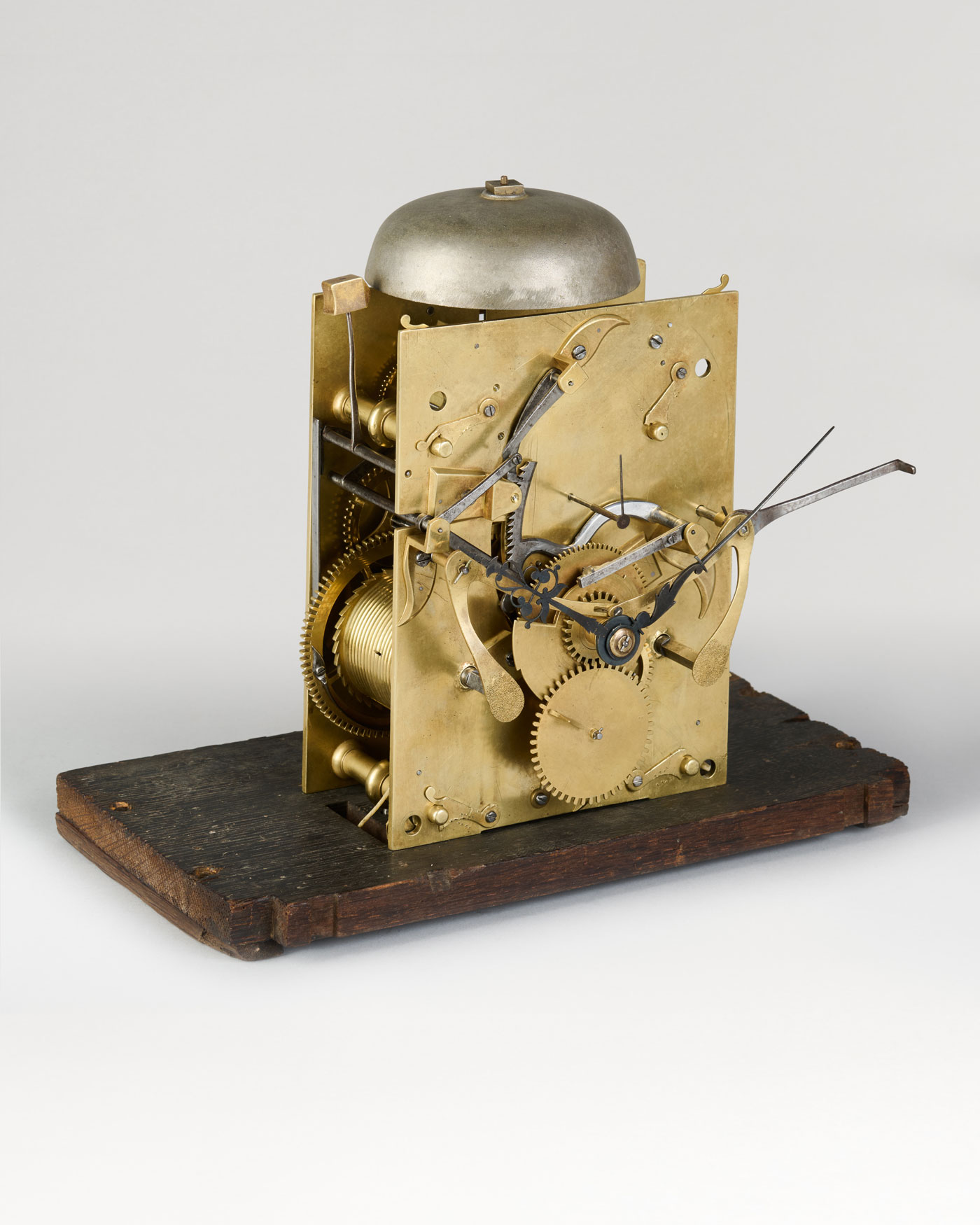
The dial feet and five pillars to the movement are all latched. There is an anchor escapement and rack striking sounded on a bell. The backplate is punch numbered 638 at the base and the movement is complete with its original pendulum, large brass bob and calibrated rating nut and a pair of brass cased weights.
Height: 91 in (231cm)
Max. Width: 18 ⅞ (48 cm)
Max. Depth: 10 ⅜ in (26.5 cm)
* George Graham was born near Wigton in Cumbria in 1673-74. In 1688 he became apprentice to Henry Aske in London. In 1695 he was made Freeman of the Clockmakers Company and went to work as a Journeyman with Tompion, in the same year marrying Tompion’s niece, Elizabeth. Tompion and Graham became partners but only a few clocks were signed by them both. Graham is credited with having invented the deadbeat escapement in 1715 and also the mercury pendulum. On inheriting Tompion’s business on his partner’s death in 1713 he continued Tompion’s numbering series, but clocks by Graham are quite rare. It appears that he made only about 174 clocks himself, numbered from 600 to 774 and, like his partner, all were of the finest quality. In 1722 he became Master of the Clockmakers Company and in 1726 he invented the cylinder escapement for watches. “Honest George”, as he was known, was the first clockmaker to be appointed a Fellow of the Royal Society and on his death in November 1751 he was buried alongside Tompion in Westminster Abbey.
References Cescinsky & Webster, English Domestic Clocks, p.22, p.99, p.233, p.290, p.315
Dawson, Drover, Parkes, Early English Clocks, p.299, pl.426
B. Loomes, Clockmakers of Britain: 1286 – 1700, p. 223
B. Loomes, Clockmakers of the World: 21st Century Edition, p. 315
HW6346
123 Kensington Church Street, London W8 7LP | +44 (0) 20 7938 1100 | info@howardwalwyn.com
Copyright © 2025 Walwyn Antique Clocks
You have not viewed any products yet.