| Origin | London |
|---|---|
| Date | circa 1700 – 1710 |


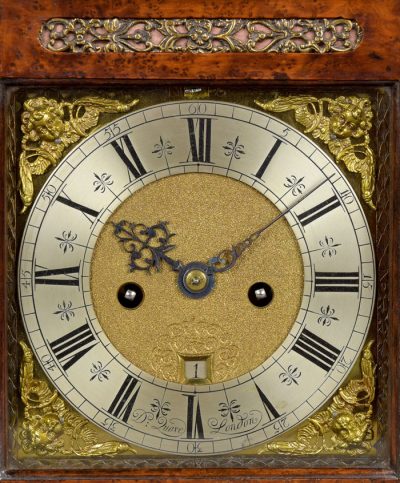
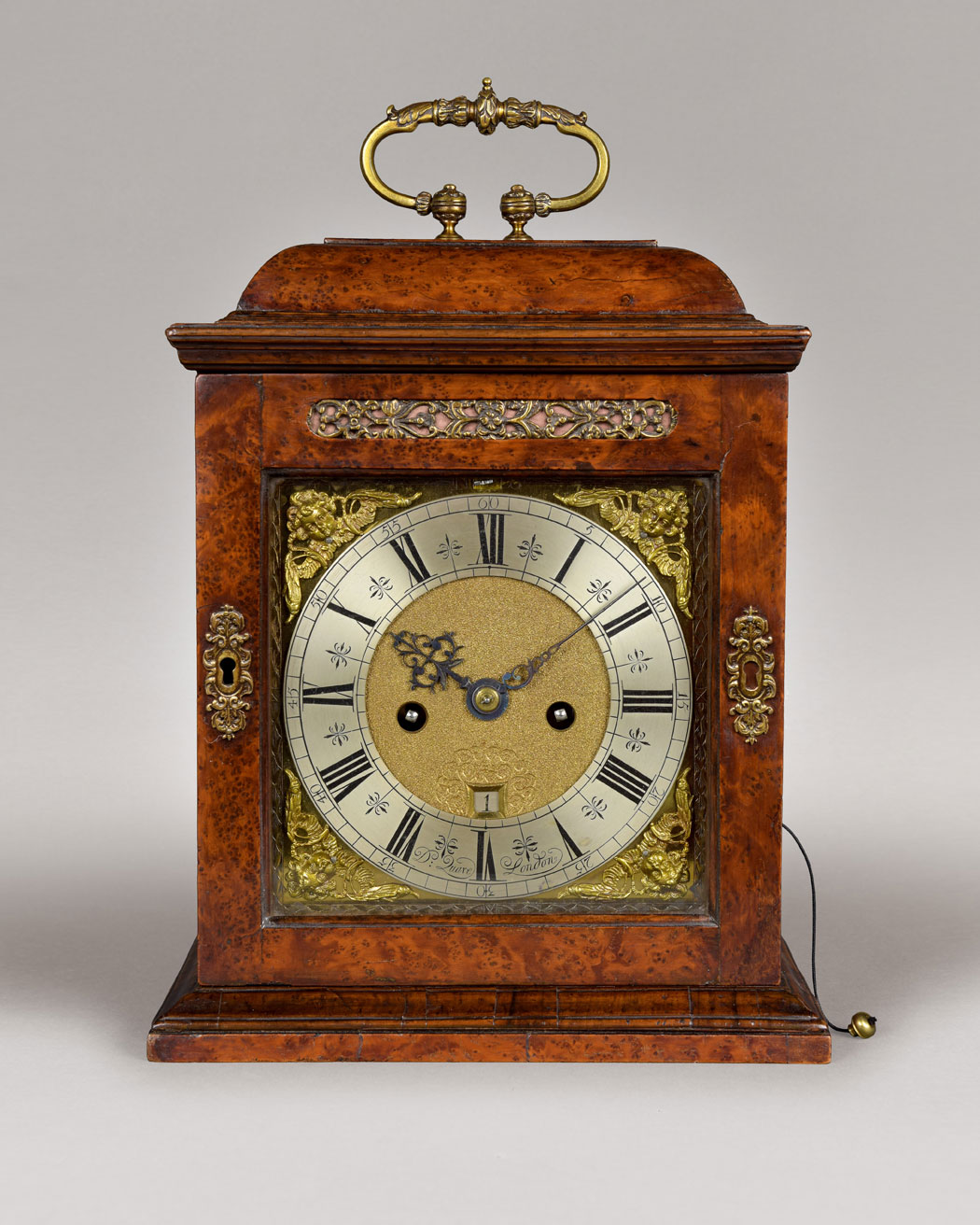
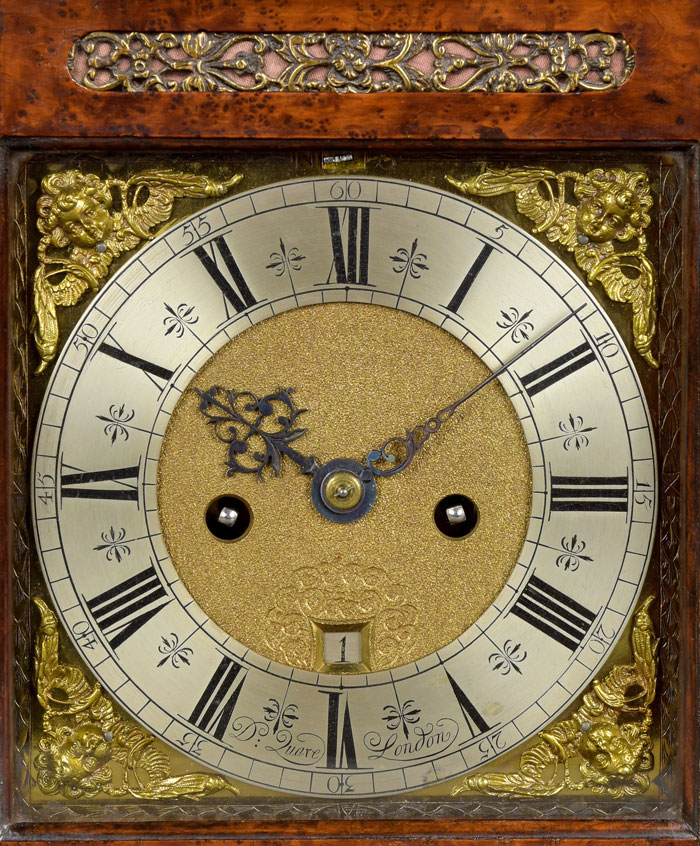
A rare Queen Anne period walnut and burr yew wood bracket clock by this famous Royal Clock maker. The fully restored 8-day movement with its verge escapement and rack strike runs for 8 days, sounds the hours on a bell and has a pull repeat mechanism for recalling the last hour and last quarter hour on three bells. The dial has four winged cherub head corner spandrels with an outer wheat ear engraved border and inset date work. The maker’s name, D. Quare, London, is engraved on the silvered chapter ring outside the finely matted centre.
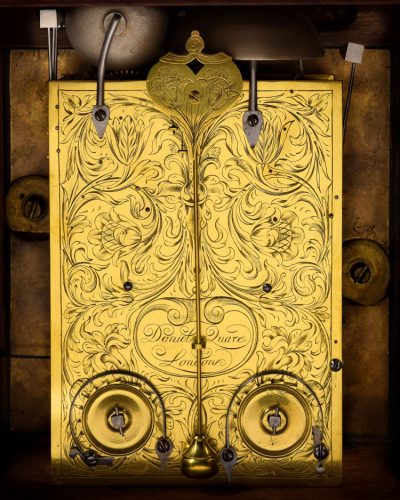
The backplate also bears the maker’s signature, Daniel Quare, London, engraved within a cartouche set below scrolling foliage and four intertwining tulips.
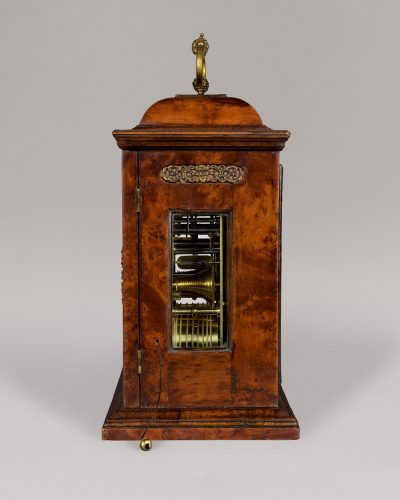
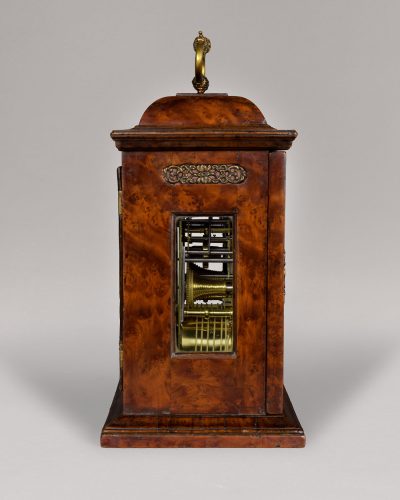
The exceptional walnut and burr yew wood veneered case is in remarkably original condition. It has its original brass foliate carrying handle and gilt brass sound frets. Its small size and shallowness are of particular appeal, as is the rich mellow colour and patination of the burr yew veneers.
Very few burr yew and walnut veneered table clocks with square dial movements by Thomas Tompion or Daniel Quare have survived. This is the first such example by Daniel Quare we have been privileged to handle.
Date: circa 1700-171o
Height: 12 ¾ in (33 cm)
Width: 10 ½ in (27 cm)
Depth: 7 in (17.75 cm)
*Daniel Quare is one of the great names from the finest period of English clockmaking and he was a justly worthy contemporary of Thomas Tompion, George Graham, Daniel Delander et al. He was born in Somerset in 1649, he became a Brother of the Clockmakers’ Company in 1671 and went on to serve as Master in 1708.
Quare was living in the parish of St Martin-le-Grand in the mid-1670s but by 1681 was in Allhallows Lombard Street. By 1686 he had made the important move to the heart of the city – Exchange Alley in the parish of St. Mary Woolnoth, taking over the premises formerly occupied by Robert Segnior. Apart from his highly successful clock business, he is believed to have made large sums of money by speculating cleverly in stocks and funds. His shop sign was ‘The King’s Arms’ and his neighbours were a vintner and a confectioner.
In about 1701 he took on Stephen Horseman as an apprentice. He became a partner in 1718 and continued the business after Quare’s death in 1724. Daniel Quare’s reputation rests both on the fact that he was a great innovator and on the fine quality of his work. He and Tompion were the first to make some highly important walnut longcase clocks of year duration showing the equation of time and other complications. One of these is now in the Ilbert Collection in the British Museum. He was also successful in a judgement made by James II in 1688 for a Patent for a repeating watch, his rival being the Rev. Edward Barlow. Among his other inventions was a portable barometer and many superb examples exist in important collections today.
Quare was an arch rival to Thomas Tompion, but as a practising Quaker he would not sign any oaths of allegiance. His Quaker beliefs thus prevented his appointment as Clockmaker to the King. He also often came into conflict with the authorities because of his refusal to pay tithes. Goods of the value of the tithe were then seized from him. Things improved after the Toleration Act of 1689 and he later served on the Parliamentary committee of the Meeting for Suffering.
Despite his Quaker faith, Quare still enjoyed royal patronage and he was a regular visitor at the Royal Palace where he was ‘free of the back stairs’. In 1691/2, he supplied William III with a repeating watch costing £69 17s 6d, and at Hampton Court a fine 10-feet year-going walnut solar/mean-time longcase clock which still stands in King William’s bedroom. He is also known to have supplied a small dual balance or pendulum controlled travelling clock at Windsor and three barometers, two of which are still at Hampton Court.
He had a highly successful business and counted many members of the Nobility and Foreign Ambassadors amongst his clientele.
Towards the end of his life he retired to Croydon where he died, aged 75, on March 21st 1724. He was buried at the Quaker Burial Ground, Bunhill Fields on the 27th of March.
References:
Dawson, Drover and Parks, Early English Clocks
Richard Garnier, ‘Innovation and Collaboration’
Brian Loomes, Clockmakers of Britain: 1286 – 1700, pp.406-407
CC03
123 Kensington Church Street, London W8 7LP | +44 (0) 20 7938 1100 | info@howardwalwyn.com
Copyright © 2025 Walwyn Antique Clocks
You have not viewed any products yet.