| Origin | London |
|---|---|
| Date | circa 1690 |


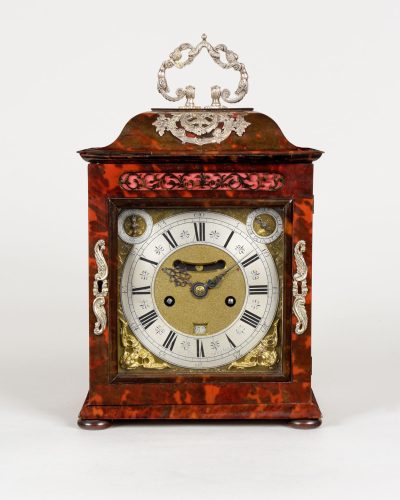
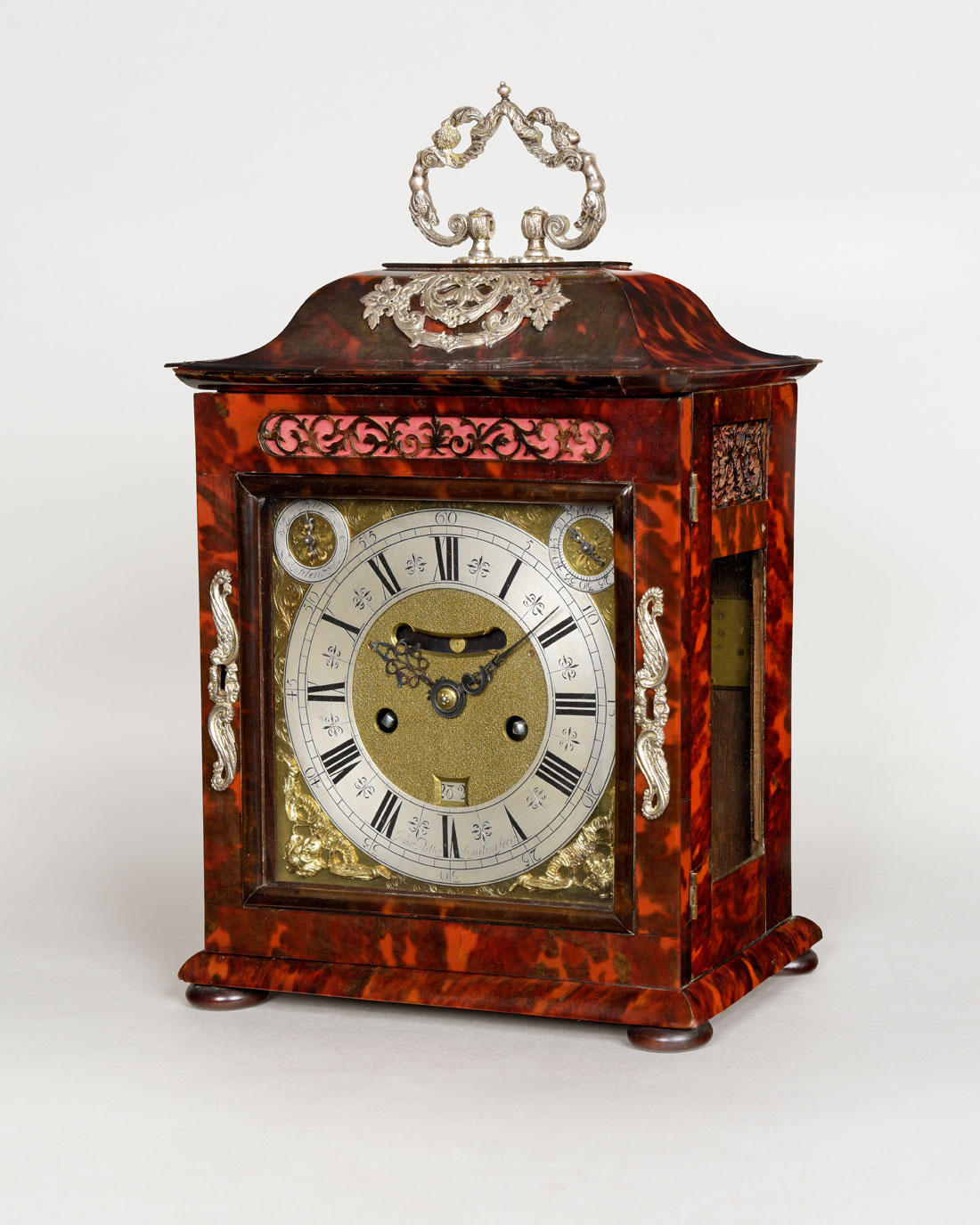
A fine and rare late 17th-century table clock of small proportions veneered in tortoiseshell by this well-known London maker.
The small rectangular case is veneered with rich tortoiseshell and adorned with finely pierced silver mounts. It is surmounted by a cast silver twin-figural carrying handle on a shallow caddy top, which is embellished at the front and rear with pierced foliate scroll frets. The glazed front door has a silk-backed sound fret above the dial, over a pair of ornate silver escutcheons in the Joseph Knibb style. The sides are fitted with similar pierced sound frets above rectangular glazed panels, and the glazed rear door is likewise set with a conforming fret. The clock stands on a moulded base with four turned silver bun feet.
The 6-inch square brass dial features a silvered chapter ring with Roman hours and Arabic five-minute numerals. The maker’s signature, Jonat. Puller, Londini fecit, is engraved on the lower edge of the chapter ring between V and VII. Twin subsidiary dials for Strike/Silent and for rise-and-fall regulation are set near the top, interspersed with delicate scroll engravings. The finely matted dial centre has a mock pendulum aperture and a date window above VI, and the spandrels are adorned with winged cherub-head mounts in the lower corners. The time is indicated by a pair of finely pierced blued steel hands.
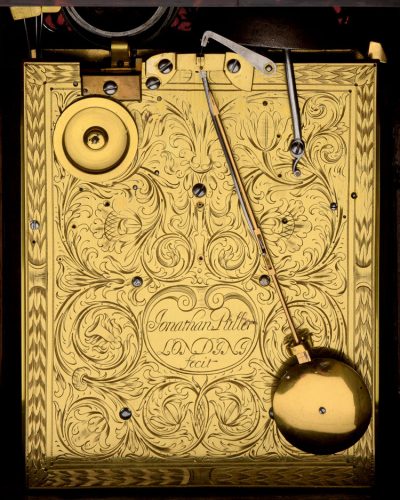
The clock is equipped with a high-quality twin-fusee movement secured by five latched vase-shaped pillars. It has a verge escapement with a short spring-suspended pendulum terminating in a lenticular bob. The hour strike is released by a rack-and-snail mechanism sounding on a single bell, and the clock incorporates a quarter repeat system that chimes the quarters on a nest of six graduating bells with corresponding brass hammers. The backplate is finely engraved, featuring an unusual chamfered edge and a wide wheatear border framing symmetrically arranged scrolls and flowerheads, with a central cartouche inscribed with the maker’s signature Jonathan Puller Londini Fecit.
Date: circa 1690
Height: 14 inches (36 cm) including handle
Width: 9 ½ inches (24 cm)
Depth: 6 ⅛ inches (15.5 cm)
Jonathan Puller (c. 1662 – c. 1707) was a respected London clockmaker of the late 17th century. Apprenticed in 1676 to Nicholas Coxeter (and transferred to John Miller in 1679), he became Free of the Clockmakers’ Company in 1683. Puller established his workshop in Red Lion Court off Fleet Street, close to Thomas Tompion’s premises. Over the next two decades he trained eight apprentices and was appointed an Assistant of the Clockmakers’ Company in 1701. He remained active until about 1707, when records of him cease and he is presumed to have died.
This particular clock is illustrated on multiple pages of Early English Clocks, by Percy G Dawson, C.B Drover and D.W Parkes. It is a beautiful example of some of the earliest use of tortoiseshell veneers on a bracket clock case, and is even more unusual for its silver mounts.
HW6662
123 Kensington Church Street, London W8 7LP | +44 (0) 20 7938 1100 | info@howardwalwyn.com
Copyright © 2025 Walwyn Antique Clocks
You have not viewed any products yet.